Amina Siječić Selimović
Architect of Knowledge for Democracy and Human Rights
Amina is a researcher and communicator with a background in philosophy. Her work lies at the intersection of education, democracy, human rights and youth participation.
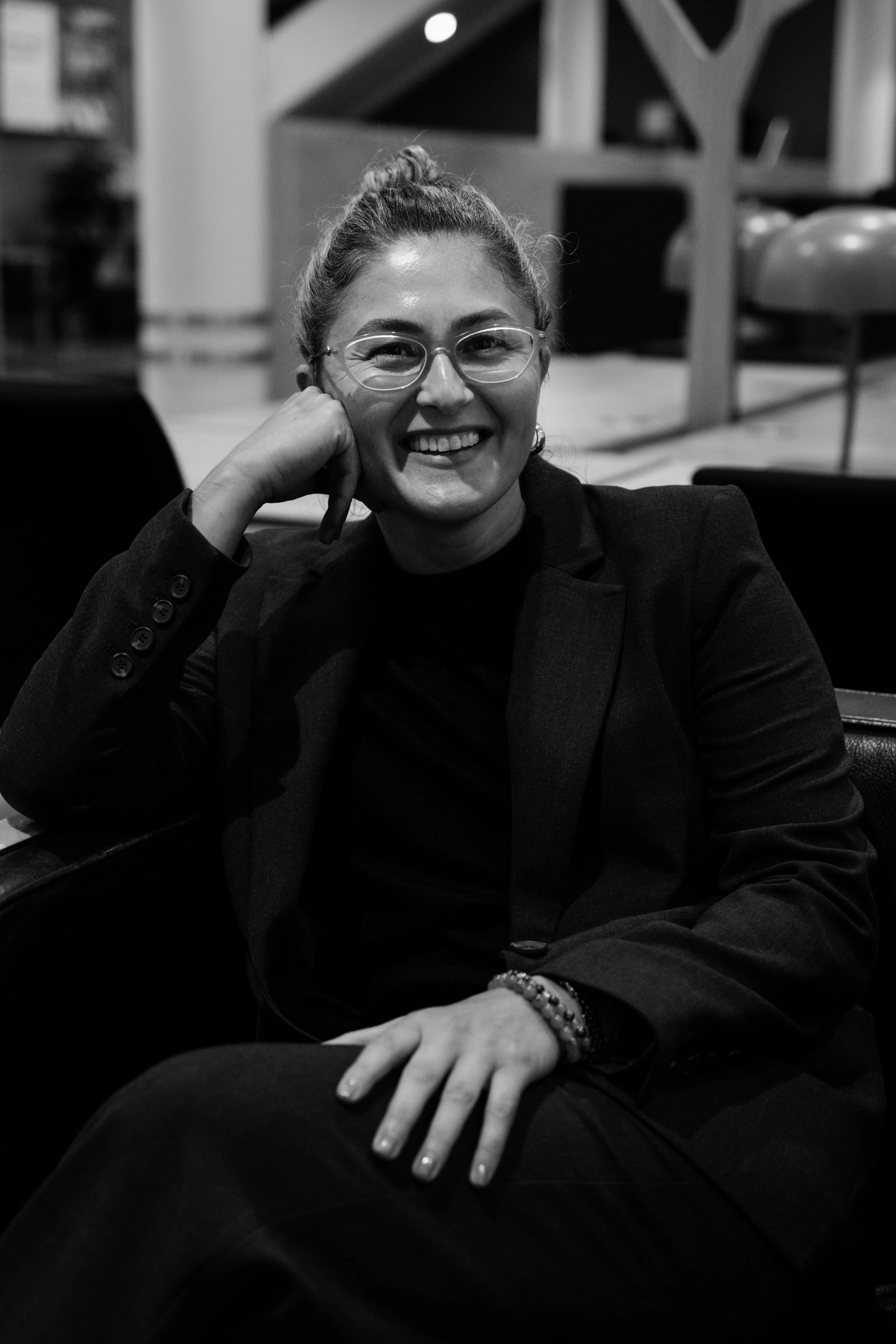
She makes complex societal issues understandable, actionable and inspiring.
Amina analyses ethics, knowledge and society, translating her insights into concrete policy proposals, programme and course design, and digital learning tools used in schools, universities and public-sector institutions.
She has extensive experience leading interdisciplinary teams, developing study programmes and building strategies that make complex issues understandable and manageable in everyday practice.
Background
Amina came to Norway as a refugee from Bosnia in 1992. Her childhood experiences – war, displacement and violations of fundamental rights – taught her that democracy and human rights are not abstract ideals, but fragile practices that depend on knowledge, robust institutions and people who take responsibility. This insight shapes both what she does and how she does it.
As a young person, Amina had few tangible role models. Kofi Annan and Nelson Mandela became important sources of inspiration because they demonstrated how values-based leadership can unite responsibility, dignity and principle, even in the most challenging circumstances. Their examples have inspired her to make democracy and human rights understandable in practice.
Amina’s academic background spans ethics, human rights, religious studies and educational research, as well as information literacy, critical evaluation of sources and the responsible use of artificial intelligence in higher education. She also has practical experience in preparedness and dialogue work related to 22 July, negative social control and other sensitive issues.
Her aim is to give young people the knowledge she herself lacked – knowledge that gives them the confidence to think critically, ask questions and participate actively in democratic processes. When understanding of democracy and human rights is strengthened, society becomes more resilient, more inclusive and better equipped to meet the challenges of the future.
Professional profile
Amina is a scholar of religion, specialist in Islam and dialogue, and educator. She works across research, teaching and practice, with a particular focus on issues related to democracy, human rights and sensitive topics.
As a scholar of religion, Amina works with Islam in Norwegian and European contexts, and with how religion is understood and communicated in schools, education and public debate. She also writes textbooks for the Norwegian school subjects KRLE and Religion and Ethics (RE), and is concerned with how knowledge is presented to students, which perspectives are emphasised, and which simplifications are often taken for granted when religion, identity and society intersect.
Amina has extensive experience in dialogue work in contexts marked by vulnerability, conflict and strong tensions. This includes work related to 22 July, negative social control, belonging and societal conflict. For her, dialogue is not about creating consensus, but about making disagreement possible to navigate in responsible and knowledge-based ways.
As an educator, Amina is committed to creating safe spaces for learning and reflection, including when the topics are challenging. She works to make complex knowledge accessible without oversimplifying it, and to give young people in particular the language and tools to think critically, ask questions and participate.
Her work is grounded in a commitment to strengthening democratic understanding and responsible practice when engaging with complex and sensitive societal issues.
Approach
“For me, dialogue is a deliberate and structured process that creates space for both disagreement and vulnerability, and that can continue in other arenas when the parties are not meeting face to face. The aim is not necessarily to achieve consensus, but to establish safe frameworks in which conflicts can be mapped, understood and transformed into concrete possibilities for action.”
Amina’s work centres on democracy, human rights and the role of knowledge in society. With an academic foundation in religious studies and practical experience from schools, universities and the public sector, she currently works with writing, public engagement and project development at the intersection of research, public discourse and practice.
Through her work in areas including interreligious dialogue and the quality of education, Amina has developed a realistic, tool-oriented approach to dialogue: a safe space in which disagreement can be expressed without relationships breaking down, and where language and clear frameworks make it possible to identify what people disagree about and why.
In practice, this involves a structured focus on safety, clear frameworks and a shared language. For young people, dialogue is about being seen as thinking and feeling individuals, rather than simply as statistics or “voices” to be heard. Amina’s approach starts with the concrete challenges young people encounter in everyday life: polarisation, conflicts of loyalty, exclusion and the pressure to take a position quickly.
The aim is to make democracy a skill that is practised in everyday life, rather than merely an academic subject to be studied. In this way, knowledge of democracy, human rights and critical thinking can become a practical tool that strengthens both individuals and society when confronting complex and sensitive issues.
Publications and Writing
-
Religion og etikk for VGS, kapittelet «Islam». Cappelen Damm (2022, 2026).
KRLE for 5. trinn. Cappelen Damm (2026).
KRLE for 6. trinn. Cappelen Damm (2027).
KRLE for 7. trinn. Cappelen Damm (2027).
-
Interview: Religioner.no – «Muhammed-bilder kostet universitetslektor jobben».
Essay: St. Sunniva (2020) – «Traumer og omsorg».
Columnist at Vårt Land (2020–2023): et utvalg kronikker.
-
Selimovic, A. S. (Vår, 2026). «Musikk som identitetsrom. Sevdah, Karpe og lyd som hjem i bevegelse». Kirke og Kultur.
Selimovic, A. S. (Høst, 2026). «Textbook Theology». Special issue: Beyond non-Muslim Islam, Journal of Muslims in Europe.
Selimovic, A. S. & Baugerud, T. (2025). «Vi har Bibelen, muslimene har Koranen». Scandinavian Journal of Islamic Studies.
Berglund, J., Gilliam, L. & Selimovic, A. S. (2023). «The teaching of Islam in Scandinavia». Scandinavian Journal of Islamic Studies, 17(2).
Selimovic, A. S. (2023). «Mødre og morskap i Koranen». St. Sunniva, 1/2023 (essay).
Selimovic, A. S. (2017). Review: Irene Schneider – Women in the Islamic World. Theology & Sexuality, 22(1–2).
Selimovic, A. S. & Thomas, P. (2015). «Sharia on a Plate?» Journal of Islamic Marketing, 6(3), 331–353.
-
Guest Editor: Islamic Education in Scandinavia, SJIS (2023).
Journal Editor: Gender and Islam, SJIS (2023).
Editorial Board Member: SJIS (2020–2025).
Editorial Board Member: Kirke og Kultur (2021–2024).
-
Book Project (Fritt Ord): Makt, tabu og kjønnsrettferdighet i islam (2020–2024)
Education
-
Leadership and Financial Management
2026
NKI -
University Pedagogy
2015–2018 -
Master’s Degree in Religion and Society, specializing in Islam
2007–2009
Universitetet i Oslo -
Practical Pedagogical Education (PPU)
2006
Universitetet i Oslo -
Bachelor’s Degree in Culture and Social Sciences
2003–2006
Universitetet i Oslo
Invite Amina
Would you like to invite Amina to give a talk or teach at your organisation or institution? Get in touch for an informal conversation about how she can contribute.
Amina Siječić Selimović